Medusa vs Shopify: The Real 2026 Cost Breakdown
An honest cost comparison: Shopify plans and transaction fees against self-hosted Medusa, calculated across three scenarios over three years. Including the result vendor content leaves out: sometimes Shopify wins.
 Pawel Owerczuk12 min
Medusa versus Shopify comes down to two business models: renting versus owning. I earn from neither platform. I build systems on top of them. So this comparison runs the numbers honestly on both sides, including the result vendor content never prints: in one of the three scenarios, Shopify wins comfortably.
TL;DR: Shopify costs £19–344 per month in the UK plus up to 2% in transaction fees with external payment providers; Plus starts at £1,800 per month. Medusa is MIT-licensed and costs nothing as software. You carry hosting ($25–60 per month) and development instead. Over three years, Shopify wins the standard-shop scenario; Medusa wins where deep customization or a marketplace is involved.
All prices in this article: checked 27 August 2026, in the currency of the source pricing page, no conversions.
Medusa vs Shopify at a glance
| Dimension | Shopify | Medusa |
|---|---|---|
| Model | SaaS rental | open-source framework (MIT), self-hosted or Cloud |
| Software cost | £19–344/mo, Plus from £1,800/mo | £0 license; Medusa Cloud from $29/mo |
| Transaction fees | 0.2–2% with external payment provider | none |
| Hosting | included | your job (realistically $25–60/mo) |
| Development required | optional (theme/apps) | mandatory (TypeScript team) |
| Time to launch | days | weeks |
| Code ownership | no (Liquid themes, app ecosystem) | full |
| B2B / custom logic | via apps and Plus features | core strength (modules, workflows) |
| Marketplace / multi-vendor | not native, apps only | via Mercur or custom build |
| Compliance / hosting sovereignty | US SaaS with EU data centers, DPA | your choice, EU or on-premise |
| AI readiness | vendor AI inside a closed system | API-first, official MCP server + agent skills |
Eleven rows, but it really comes down to one question: do you need logic that Shopify does not rent out? The rest is arithmetic; the numbers follow below.
What does Shopify actually cost in 2026?
Shopify's UK pricing page lists four plans, checked live on 27 August 2026:
| Plan | Monthly | Yearly (−25%) | External payment provider fee |
|---|---|---|---|
| Basic | £25 | £19/mo | 2% |
| Grow | £65 | £49/mo | 1% |
| Advanced | £344 | £259/mo | 0.6% |
| Plus | from £1,800/mo | — | 0.2% |
Checked 27 August 2026, shopify.com/uk/pricing; Plus terms per shopify.com/plus/pricing (3-year term; higher on 1-year).
The most important footnote sits in the last column: the transaction fee only applies if you do not use Shopify Payments. Stay on Shopify Payments and it disappears. But route payments through an external provider — a dedicated B2B payment service, a local PSP, PayPal directly — and Shopify takes an extra 0.2–2% of every pound of revenue. On £1M a year on Grow, that is £10,000 annually: the price of the freedom to choose your own payment stack. (Shopify Payments itself charges UK online card rates of 2% + 25p on Basic down to 1.5% + 25p on Advanced — comparable to what you would pay a PSP directly, which is why this comparison counts only the platform's extra fee.)
What does self-hosted Medusa actually cost?
Medusa's core is MIT-licensed and free to self-host; there is no license fee and no GMV share. The real costs live elsewhere: infrastructure and development time.
I have my own numbers for infrastructure: my Medusa marketplace with 10,000 products and 50 vendors runs on Railway for $40–60 a month, everything included: backend, worker, PostgreSQL, Redis. Product images live in Cloudflare R2, where egress is free; for typical catalogs R2 stays under a dollar a month. Based on Railway's usage-based pricing, a small shop lands around $25 a month and larger setups at $55–60.
Prefer managed hosting? Medusa Cloud lists four tiers: Develop from $29, Launch from $99, Scale from $299 per month, Enterprise on request. If you have seen older comparisons: the two-tier framing ($29/$299) is outdated; the Launch tier in between is newer. Per the pricing FAQ there is no lock-in: data export and a move to self-hosting are supported.
The big line item is development. There is no such thing as a Medusa project without a developer team, and that is exactly what decides this comparison.
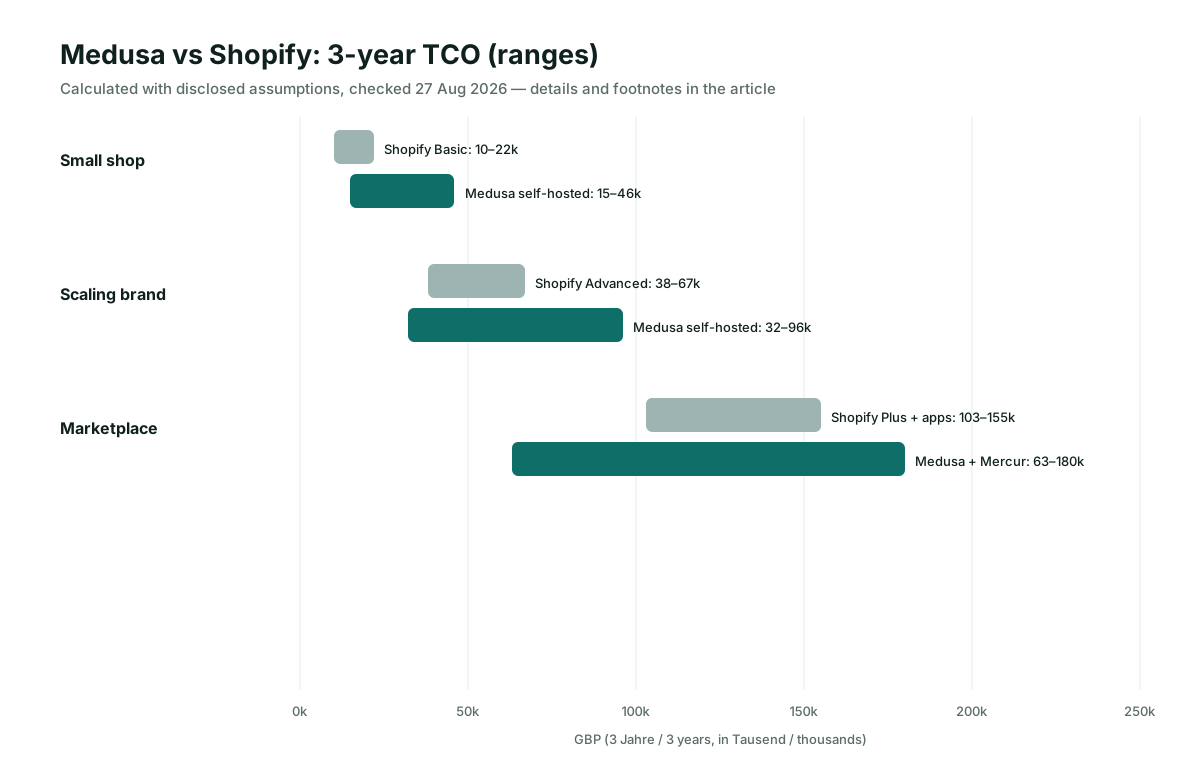
3-year TCO: three scenarios, calculated
To keep the math auditable, every assumption is on the table: day rates £700–1,000, Shopify on yearly billing with an external payment provider (with Shopify Payments the fee column drops to zero), Medusa self-hosted on Railway (hosting billed in USD, listed as-is). The development estimates are ranges drawn from my own projects; yours may differ.
Scenario 1: Small shop (£100k revenue/year, 500 products)
| Item | Shopify Basic | Medusa self-hosted |
|---|---|---|
| Subscription/license (3 yrs) | £684 | £0 |
| Hosting (3 yrs) | included | ≈ $900 |
| Transaction fee 2% (3 yrs) | £6,000 | £0 |
| Initial development | £3,500–15,000 (theme, setup: 5–15 days) | £10,500–30,000 (15–30 days) |
| Maintenance (3 yrs) | minor, mostly in apps | £4,200–15,000 (2–5 days/yr) |
| Total (3 yrs) | ≈ £10,000–22,000 | ≈ £15,000–46,000 (+ hosting) |
The result: Shopify wins this scenario. Even with an external payment provider it lands below Medusa's total, and with Shopify Payments it is not close. A small standard shop has no customization need that justifies a developer budget — I have told prospects exactly that to their faces.
Scenario 2: Scaling brand (£1M revenue/year, custom requirements)
| Item | Shopify Advanced | Medusa self-hosted |
|---|---|---|
| Subscription/license (3 yrs) | £9,324 | £0 |
| Hosting (3 yrs) | included | ≈ $1,980 |
| Transaction fee 0.6% (3 yrs) | £18,000 | £0 |
| Initial development | £10,500–40,000 (apps, theme customization: 15–40 days) | £21,000–60,000 (30–60 days) |
| Maintenance (3 yrs) | app subscriptions + changes | £10,500–36,000 (5–12 days/yr) |
| Total (3 yrs) | ≈ £38,000–67,000 | ≈ £32,000–96,000 (+ hosting) |
The ranges overlap, and that is the point. Once a brand is developing anyway (custom checkout logic, ERP integration, B2B price lists), you pay the team in both worlds. Then the calculation flips: with Medusa the budget goes into code you own; with Shopify it goes into app subscriptions, workarounds against platform limits, and a recurring fee column that grows with revenue.
Scenario 3: Marketplace (£1.75M GMV/year, 50 vendors)
| Item | Shopify Plus + apps | Medusa + Mercur (OS) |
|---|---|---|
| Subscription/license (3 yrs) | £64,800 (Plus, 3-year term) | £0 |
| Hosting (3 yrs) | included | ≈ $2,160 |
| Transaction fee 0.2% (3 yrs) | £10,500 | £0 |
| Initial development | £28,000–80,000 (multi-vendor apps + workarounds: 40–80 days) | £42,000–120,000 (60–120 days) |
| Maintenance (3 yrs) | app subscriptions (multi-vendor apps cost extra) + changes | £21,000–60,000 (10–20 days/yr) |
| Total (3 yrs) | ≈ £103,000–155,000 + app costs | ≈ £63,000–180,000 (+ hosting) |
For marketplaces the comparison is structurally skewed (if a marketplace is your actual project, my dedicated marketplace platform comparison is the better read): Shopify has no native multi-vendor model: vendor accounts, order splitting, and commission handling come from third-party apps with their own fees and their own limits. On the Medusa side, Mercur ships exactly these building blocks as an MIT-licensed marketplace layer; my independent review breaks down what is included. My own marketplace runs on this architecture in production; the full case study covers the stack, the bill, and the pitfalls.
What this calculation deliberately leaves out: Shopify app subscriptions (anywhere from zero to several hundred pounds a month depending on setup — too individual for a defensible range), design and content work (similar on both sides), and the PSPs' own payment processing fees (also comparable on both sides). The tables compare what the platform choice itself costs — not what a shop costs in total.
Development and ownership: what you are actually paying for
With Shopify you rent a product; with Medusa you own a codebase. That sounds philosophical, but the price effect is concrete: Shopify costs scale with revenue (fees, plan upgrades, the Plus threshold), Medusa costs scale with the complexity of your requirements. A standard shop never gets more expensive than planned on Shopify; a special requirement almost always does.
Add the staffing question that cost sheets rarely show: for Medusa you hire TypeScript developers — plentiful, with skills that are not platform-bound. For deep Shopify customization you hire Liquid and Shopify-app specialists, a much smaller market. Over three years, "who do I hire for this?" is often more expensive than any row in the tables above.
Then there is the question of what happens to your investment. Liquid themes and app configurations are bound to the platform; a TypeScript backend on Medusa is transferable property: auditable, versioned, movable to another host when needed. For companies with their own IT strategy, that is not a detail; it is the core of the decision.
Scaling and ecosystem: where Shopify wins
Credit where it is due: Shopify's ecosystem is unmatched. Thousands of apps, every agency knows it, every payment and shipping feature exists ready to configure, and the platform absorbs Black Friday spikes without you ever thinking about scaling. Medusa's ecosystem is growing fast (about 36,000 GitHub stars, very active development), but it remains a framework ecosystem: you build with components rather than installing finished apps, and scaling (workers, Redis, database) is your responsibility. Doable, well documented, but yours.
I can make Medusa's operational side concrete: on Railway, my individual services build in two to three minutes and deploy in parallel, and since my marketplace went live there has not been a single infrastructure incident. That is one data point, not a guarantee, but it argues against the fragile-self-hosting stereotype. The production requirements (separate server and worker processes, Redis, S3-compatible storage) are cleanly described in the Medusa deployment docs and, once set up, unremarkable.
A word on the third option: Medusa Cloud makes sense when you want the framework but nobody on the team should own infrastructure — from $29 a month the vendor takes hosting, backups, and scaling, with no lock-in per its own FAQ. There is a middle ground between running everything yourself and renting everything.
Compliance and hosting sovereignty: where Medusa wins
For European businesses this is often the quiet decider. Shopify is a US SaaS — operable in a GDPR-compliant way, with data processing agreements and EU infrastructure options, but data processing stays bound to a US corporation and its legal framework. Self-hosted Medusa flips that: customer data lives wherever you decide — EU cloud, local data center, or on-premise — and the data flow ends at your infrastructure boundary. In regulated industries and B2B with sensitive pricing data, this argument regularly overrides the cost math. More on how I build such setups on my e-commerce industry page.
AI readiness: the row that matters more in 2026
The last row of the comparison table deserves its own paragraph, because classic comparisons skip it. Medusa is built API-first and ships official tooling for AI-assisted development: an MCP server and Claude Code agent skills that let coding agents work directly against the framework. In practice that means the customizations which tip the TCO comparison toward Medusa are themselves getting cheaper; by how much, I show in my guide to Medusa.js and AI agents. Shopify has its own AI features, but they live inside the vendor's closed system: you use what Shopify builds, at the pace Shopify sets. If you treat AI agents as part of your development workflow, the open side simply offers more surface to work with. More on this in the AI agents topic.
Who should choose what?
Choose Shopify if your catalog and checkout are standard, no developer team is available, or time to market beats everything. The math above is unambiguous, and I stand by it as someone who earns money on Medusa projects.
Choose Medusa if custom logic is getting a budget anyway: B2B approvals, your own pricing models, ERP orchestration, a marketplace. (Weighing Medusa against other open-source platforms instead? My Medusa vs Vendure vs Saleor comparison covers that fork.) From that point on, Shopify sells you workarounds and Medusa sells you ownership — at an overlapping price.
Not sure which case you are? That is precisely what my architecture audit answers in one to two weeks: with numbers for your specific shop instead of scenario ranges.
Migration: what a switch realistically means
Moving from Shopify to Medusa is a development project, not a button: products and customers export cleanly via API, order history and app functionality are manual work, and the checkout gets rebuilt. Depending on complexity, expect weeks to a few months. My own migration came from WordPress/WooCommerce and taught me more than I wanted to learn; the details are in the case study. The typical sequence has five steps: export products and customers via API, import and remodel the catalog in Medusa, rebuild checkout and payment providers, set up redirects for every old URL, then run a parallel phase with test orders. One trap worth naming upfront: customer passwords never migrate between shop systems — your customers reset them once, and that belongs in your communication plan, not your bug list.
The reverse path (Medusa to Shopify) is easier, by the way; that belongs in a fair comparison too. Just migrate for concrete requirements, never for ideology. All articles in this series live on the e-commerce topic page, and the wider platform landscape is mapped in my open source ecommerce field guide.

AI Agent & RAG Developer
AI Agent & RAG Developer with 10+ years of software engineering experience. Specialized in intelligent AI solutions for enterprises in the DACH & Nordic region.
More about me