Mercur vs Sharetribe vs Mirakl: Which Marketplace Platform?
Open source vs SaaS vs enterprise: the three marketplace platform models compared on cost structure, ownership, time to market, and EU compliance, by someone who runs a marketplace and sells none of these products.
 Pawel Owerczuk10 min
Almost everything written about marketplace platforms is written by marketplace platform vendors. Rigby compares Mercur to Mirakl on Rigby's own blog; Sharetribe explains why SaaS beats open source; Mirakl sells the enterprise story. Every one of those texts may contain true sentences, and every one of them was written to sell you something.
I sell implementations, not platforms. My own marketplace (10,000 products, 50 vendors) runs on the Medusa stack that Mercur builds on, so I know that side at operator depth and say so openly. What follows: verified prices with dates, third-party estimates labeled as such, and a cost model at three scales that does not pretend open source is free.
TL;DR: Three models, not three competitors. Sharetribe is SaaS convenience: live in days, $99–299 per month plus per-transaction fees. Mercur is open-source ownership: no platform fees, MIT license, but you bring developers. Mirakl is the enterprise operator suite: category leader, sales-quoted pricing, enterprise budgets. Pick the model first; the product follows.
The three platforms at a glance
| Dimension | Mercur | Sharetribe | Mirakl |
|---|---|---|---|
| Model | open source (MIT) on Medusa | SaaS | enterprise SaaS |
| Platform cost | $0 license | $99–299/mo (billed yearly) | sales-quoted, no public price |
| Per-transaction fees | none | $0.19 or less beyond plan quota | not public |
| Hosting | yours (realistically $25–60/mo) | included | included |
| Developers required | yes (TypeScript) | no (for standard flows) | integration project |
| Time to first live marketplace | weeks | days | months (enterprise rollout) |
| Code ownership | full | none | none |
| Custom logic depth | unlimited (it is your codebase) | within platform limits | enterprise configuration |
| EU data sovereignty | any infrastructure incl. on-premise | DPA-based | DPA-based |
Prices checked 27 August 2026 at each vendor's pricing page; details and sources below.
Cost models: the section that actually decides this
The three platforms charge in three unrelated ways, which makes naive comparisons meaningless. Here is each model, verified:
Sharetribe charges a subscription plus transaction overage. Per sharetribe.com/pricing: Build at $39/month is a development environment only; live marketplaces need Lite ($99), Pro ($199), or Extend ($299) per month billed yearly, including 50, 250, and 500 transactions monthly. Beyond that: $0.19 or less per initiated transaction, with volume discounts. Worth pausing on: Sharetribe takes no percentage commission; Stripe's processing fees (roughly 1.5–3%) are a separate third-party cost you would pay in any model. A "transaction" is broadly defined (an order, a booking, even a conversation thread), which matters for high-inquiry marketplaces: a services marketplace where ten inquiries produce one booking burns its quota ten times faster than a retail one — same GMV, very different bill. Model your own inquiry-to-order ratio before trusting anyone's cost table, including mine.
Mercur charges nothing: MIT license, zero GMV fees. The costs move to infrastructure and people. My production numbers for the underlying stack: $40–60 per month on Railway for backend, worker, PostgreSQL, and Redis at my scale, with images in Cloudflare R2 for under a dollar. The real budget line is development; my independent Mercur review breaks down what the platform includes and what you still build.
Mirakl publishes no pricing for its operator platform; every path on mirakl.com leads to sales. The only attributed third-party number I found: Vendr, a SaaS purchasing platform, reports contracts "typically around $90,000" annually, methodology undisclosed, so treat it as a rough order of magnitude; nobody signs a contract off a blog post. Competitor blogs circulate much higher enterprise figures; I could not corroborate them at any analyst or primary source, so they stay out of this article. One genuine trap worth naming: Mirakl Connect has a public price list ($699–2,299 per month), but Connect is a product for sellers joining marketplaces, not for operators running one. It is an easy number to pencil into a budget draft by mistake.
What that means at three scales
Assumptions on the table: average order value $60, day rates £700–1,000 (as in my platform cost comparisons), Mercur hosting at my verified Railway numbers, three years horizon.
| Scale (monthly GMV) | Sharetribe | Mercur (self-hosted) | Mirakl |
|---|---|---|---|
| ~$10k (starter) | Lite $99/mo, quota covers ~167 orders: ≈ $3.6k over 3 yrs | hosting ≈ $1k + development £10–30k over 3 yrs | not the target segment |
| ~$100k (growth) | Pro/Extend + overage: ≈ $15–25k over 3 yrs | hosting ≈ $2k + development & maintenance £35–100k | possible entry, sales-quoted |
| ~$1M (scale) | Extend + ~16k tx/mo overage: ≈ $120k over 3 yrs | same infrastructure logic; development scales with complexity, not GMV | Vendr's ~$90k/yr average suggests ≈ $270k over 3 yrs, before implementation |
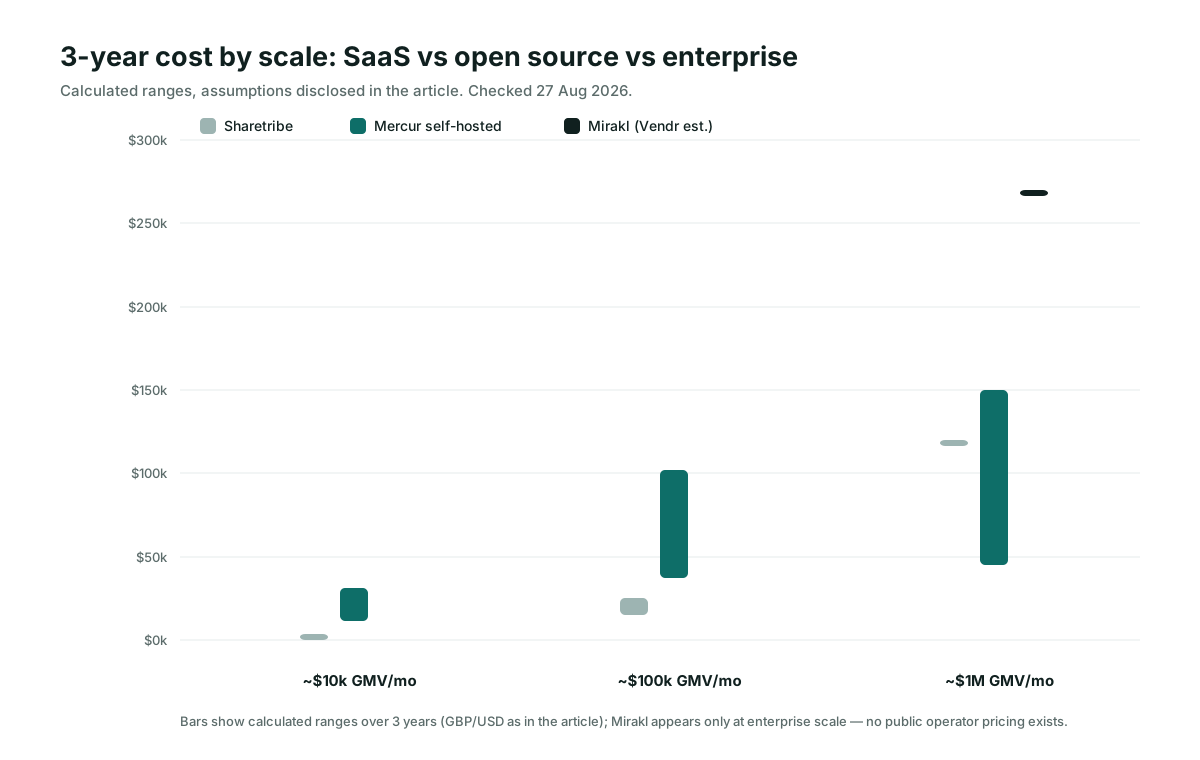
Three readings. At starter scale, Sharetribe embarrasses everything else on cost — a few thousand dollars over three years against tens of thousands in development. At growth scale the lines cross depending on how custom your marketplace is; this is where most real decisions live. At high scale the structural difference takes over: SaaS and enterprise fees track your volume forever, while an owned platform's costs track complexity — my development budget does not know what my GMV is.
Feature depth where marketplaces actually hurt
Cost models decide budgets; three specific capabilities decide operations. Vendor payouts: Sharetribe rides on Stripe's split payments within its model; Mercur ships split payments, commissions, and payout logic in the open-source tier (a real ledger with reconciliation sits in its Enterprise edition); Mirakl treats settlement as core enterprise functionality. Disputes and returns across sellers: the messiest workflow in any marketplace — Sharetribe handles the standard cases, Mercur gives you the primitives and the responsibility, Mirakl sells the process. Vendor onboarding: days of configuration on Sharetribe, a shipped panel plus your custom flow on Mercur, an enterprise project on Mirakl. If one of these three is your differentiator, weight it above everything else in this article.
Ownership and lock-in
The models differ most sharply in what you hold at the end. Three years into Sharetribe, you own your data and your brand; the marketplace logic, the workflows, the platform — those are rented, and a migration means rebuilding. Three years into Mirakl, similar, at enterprise depth. Three years into Mercur, you own a TypeScript codebase on a MIT-licensed stack: every workflow, every integration, portable to any host.
Ownership is not free — you also own the bugs, the upgrades, and the 2 a.m. questions (in fairness: my own stack has produced zero infrastructure incidents since go-live, but I planned maintenance time as if it would). The real question is which risks your organization prefers to hold. Renting keeps both your downside and your upside small. Owning removes the ceiling in both directions.
If you do migrate off SaaS later, know what moves and what does not: listings, users, and transaction history export as data; the marketplace logic (onboarding flows, commission rules, dispute handling) has to be rebuilt. Plan a SaaS exit like a replatforming project, because that is what it is. The reverse migration (owned platform to SaaS) is rarer and mostly means accepting the SaaS model's limits in exchange for dropping the maintenance budget.
For the concrete Sharetribe exit, the checklist looks like this: export listings, users, and transactions via the Integration API; rebuild onboarding, commission, and payout flows on the new stack; re-integrate payments (your Stripe account carries over, its marketplace wiring does not); map every public URL to a redirect; and run both systems in parallel for at least one full payout cycle before switching sellers over. Weeks of work, not days — priced honestly, that belongs in the comparison table too.
Time to market
At the extremes there is no contest. Sharetribe puts a standard marketplace live in days without a developer, and no open-source stack matches that; my Medusa-side builds run two to four weeks at the very minimum, realistically longer with vendor onboarding flows and payment wiring. Mirakl deployments are enterprise integration projects measured in months, which its buyers know and accept.
The nuance sits in year two. The SaaS speed advantage is front-loaded; once your roadmap collides with platform limits, feature pace inverts: the change that takes an afternoon in your own codebase becomes a feature request in someone else's backlog. Marketplaces with a differentiated model hit that wall earlier than standard ones.
Compliance and the EU angle
For European operators this deserves its own paragraph, not a table row. Self-hosted Mercur keeps vendor KYC files, customer accounts, and every transaction on infrastructure you choose — an EU cloud region, a German data center, or your own rack if procurement insists. Sharetribe and Mirakl operate as processors under data processing agreements, workable for most cases but structurally dependent on the vendor's hosting and legal posture. In regulated verticals, or when procurement asks where exactly seller KYC documents live, the self-hosted answer is simply shorter. (How the underlying stack handles this is covered on my e-commerce industry page.)
Who should pick what
Pick Sharetribe if your marketplace model is standard, you have no developers, and validation speed matters more than ownership. At starter scale it is the rational choice by a wide margin, and I say that as someone who earns nothing when you choose it.
Pick Mercur if you have a TypeScript team (or hire one), your model needs custom logic, and you want the fee meter unplugged permanently. (Still choosing the underlying framework? My Medusa vs Vendure vs Saleor comparison is the place to start; when you are ready to build, the step-by-step marketplace guide takes over.) Read my review of its maturity trade-offs first; it is a young platform, and I document exactly where that shows.
Pick Mirakl if you are an enterprise adding a marketplace to an existing retail operation, with the budget and integration teams that implies. In that segment it is the category leader; pretending otherwise would be exactly the vendor-blindness this article exists to avoid. (Marketplacer, from Melbourne, plays a related enterprise game; it layers third-party sellers onto existing storefronts via connectors for Shopify, Salesforce Commerce Cloud, and others, and is also sales-quoted.)
The compressed decision framework, since the brief version fits in one table:
| Your situation | Rational choice |
|---|---|
| standard model, no developers, validating an idea | Sharetribe |
| standard model, growing volume, fees starting to hurt | Sharetribe Extend first; re-evaluate at the wall |
| custom model or logic, TypeScript capacity available | Mercur |
| strict EU data-sovereignty or on-premise requirement | Mercur (self-hosted) |
| enterprise retailer adding a marketplace to existing operations | Mirakl (or Marketplacer) |
Undecided between the first two? That usually means growth scale with a semi-custom model, the genuinely hard case. A two-week PoC Sprint against your real vendor flows settles it with evidence instead of vendor content. Before any of that, run yourself through my Marketplace Production Readiness Checklist (free PDF, 28 checks, no email required); all my marketplace articles live on the e-commerce topic page.

AI Agent & RAG Developer
AI Agent & RAG Developer with 10+ years of software engineering experience. Specialized in intelligent AI solutions for enterprises in the DACH & Nordic region.
More about me